
Step-by-step guide on how to uninstall Microsoft Edge
If you have been searching tirelessly for how to uninstall microsoft edge from your computer, you are certainly not alone in this frustration. Millions of users feel trapped by unwanted software that seems impossible to remove, creating a sense of helplessness regarding their own devices. It is time to take back control and customize your digital experience exactly the way you deserve it to be.
For over two decades, I have seen operating systems evolve, often becoming more intrusive with each update, forcing default apps upon us without consent. This guide is your secret weapon, a proven method that bypasses standard restrictions to give you the true freedom of choice. By following these steps, you will finally be able to declutter your system and speed up your workflow.
We will walk through a powerful, yet simple process that unlocks hidden settings within your Windows system, allowing you to remove what was once permanent. You do not need to be a computer genius to follow along; you just need the desire to optimize your machine. Let’s dive in and solve this problem once and for all.
Why can’t I uninstall Edge like other apps?
Understanding the System Integration
Most users are baffled when they visit the “Add or Remove Programs” menu only to find the “Uninstall” button grayed out for Edge.This isn’t an accident; it is a calculated design choice by Microsoft to ensure their browser remains deeply embedded in the OS ecosystem.
They rely on it for background processes, Windows Search, and widget functionality, making it “essential” in their eyes, though not necessarily in yours.
The Step-by-Step Reality
To understand this restriction, you must realize that standard uninstallation paths are blocked to prevent accidental system instability.
- Open your Settings menu and try to click uninstall on Edge; notice it is disabled.
- Recognize that this block is merely a software “flag” we can toggle off.
- Accept that to bypass this, we need to go deeper than the standard user interface.
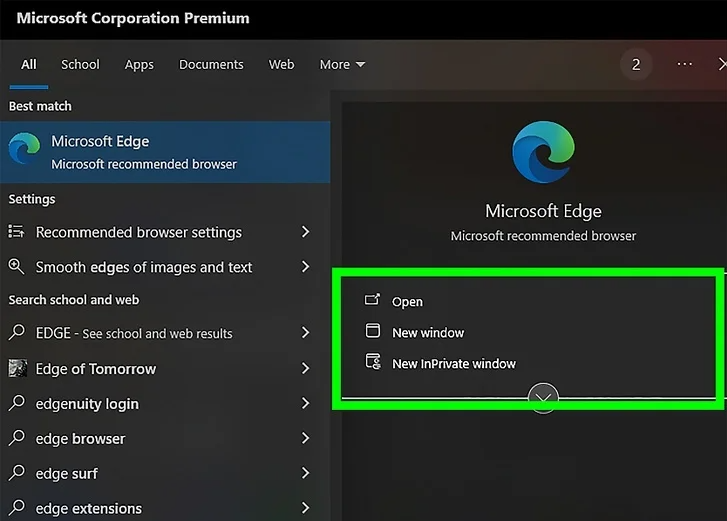
Enabling Edge Uninstall in the Registry
Unlocking the Hidden Door
This is where the magic happens; we are going to change a specific permission that tells Windows, “I am the boss here.” By tweaking the Windows Registry, we are essentially rewriting the rulebook for [how to uninstall microsoft edge] effectively. This method uses a mental trigger of exclusivity—you are accessing a layer of your computer that 99% of users never see.
The Step-by-Step Preparation
Before we proceed, ensure you have administrator rights, as we are about to modify system keys.
- Close all open browser windows to prevent conflicts.
- Create a system restore point if you want an extra safety net (optional but recommended).
- Prepare yourself to follow the exact path detailed below to unlock the uninstall feature.
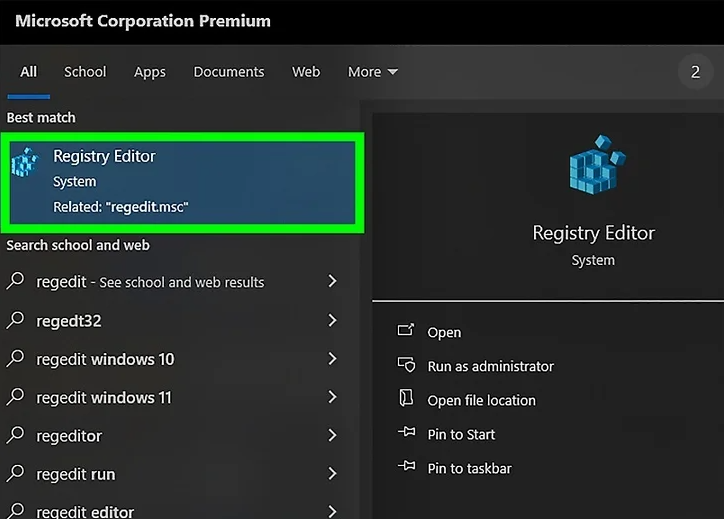
Open Registry Editor
Accessing the Command Center
The Registry Editor is the brain of your Windows operating system, holding the configuration for every single program installed. accessing this tool is the first step toward digital liberation, allowing us to modify values that the visual interface hides from us.
How to Launch It
- Press the Windows Key + R on your keyboard to open the Run dialog box.
- Type regedit into the text field and press Enter or click OK.
- Click “Yes” if the User Account Control prompts you for permission.
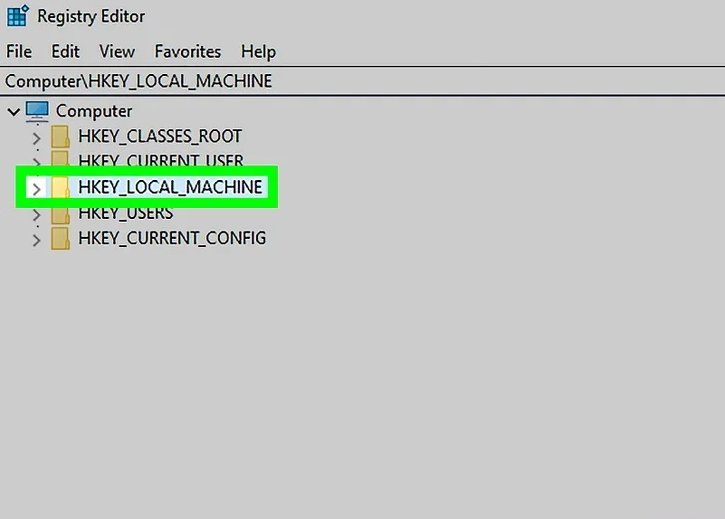
Expand the Computer folder and click HKEY_LOCAL_MACHINE
Navigating the Root Keys
Think of the Registry as a massive library; we need to find the specific bookshelf that holds machine-wide settings. HKEY_LOCAL_MACHINE is the root key that contains configuration data for the physical computer, regardless of which user is logged in.
How to Expand It
- Look at the left-hand panel of the Registry Editor window.
- Locate the folder named Computer at the very top.
- Click the small arrow (>) next to HKEY_LOCAL_MACHINE to reveal its contents.
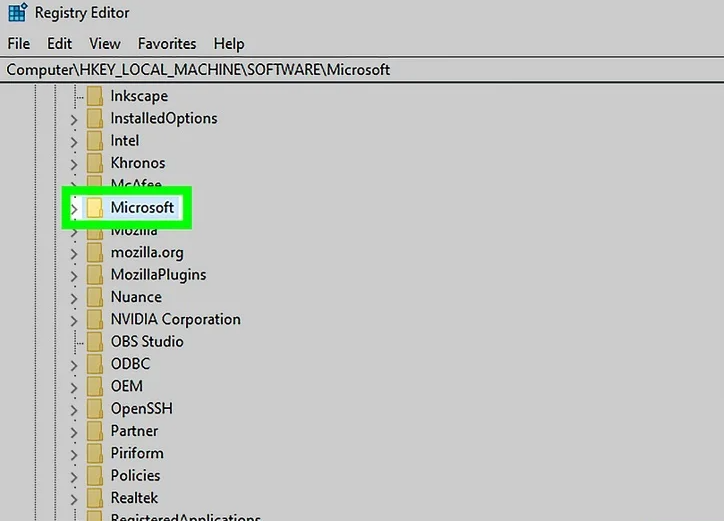
Expand the SOFTWARE folder and select Microsoft
Drilling Down to Software Configurations
We are now entering the section where all your installed software vendor data is stored. This particular folder houses the critical data for every application, and since Edge is a Microsoft product, we must look into their specific directory.
How to Locate It
- Scroll down the list under HKEY_LOCAL_MACHINE until you see the SOFTWARE folder.
- Click the arrow next to SOFTWARE to expand it.
- Scroll down again to find the Microsoft folder, but do not expand it yet; just locate it.
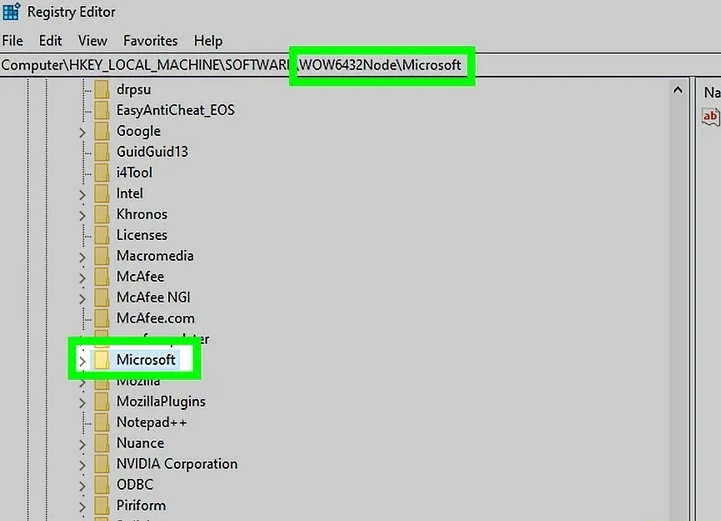
Expand WOW6432Node and select Microsoft
Finding the Correct Architecture Path
This step is crucial and often missed; because Windows runs both 32-bit and 64-bit applications, some registry keys are stored in a special redirection node. The WOW6432Node acts as a compatibility bridge, and surprisingly, the uninstall key for Edge is often hidden here.
How to Navigate Here
- Actually, instead of the standard Microsoft folder, look for WOW6432Node under the SOFTWARE folder you just expanded.
- Click the arrow to expand WOW6432Node.
- Inside this node, find the second Microsoft folder and click the arrow to expand it.
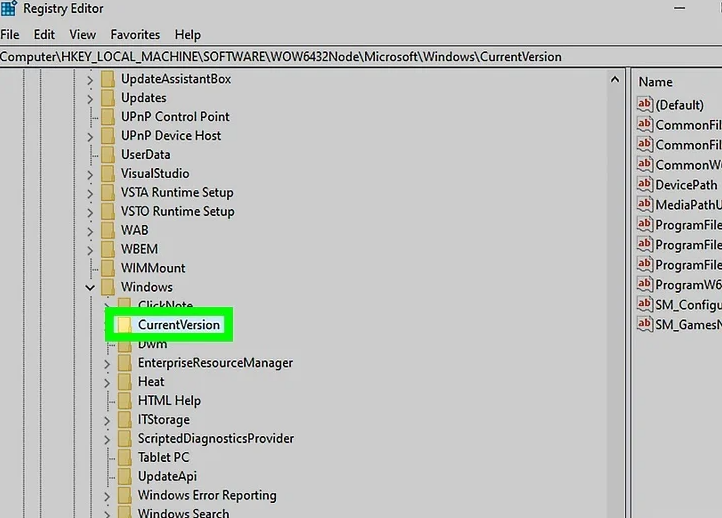
Expand Windows and select CurrentVersion
Locating the OS Version Data
We are getting closer to the core settings; this folder contains the configuration for the current version of Windows running on your machine. It is the central hub where the operating system checks for uninstall paths and display names for your programs.
How to Select It
- Scroll down within the Microsoft folder until you find Windows.
- Expand the Windows folder by clicking the arrow.
- Look for the CurrentVersion folder immediately inside it and expand that as well.
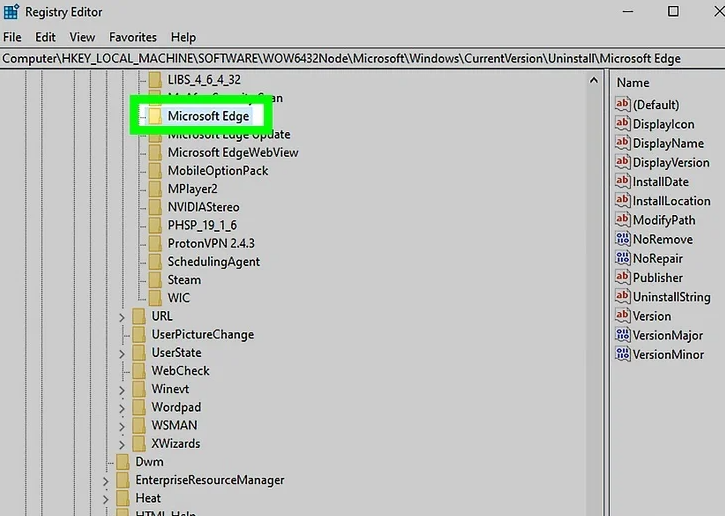
Expand Uninstall and click Microsoft Edge
Pinpointing the Target Application
This is the specific directory where Windows lists every program that can be uninstalled from the Control Panel. We are hunting for the specific entry that governs the Edge browser, which will allow us to finally learn [how to uninstall microsoft edge] by revealing its hidden properties.
How to Find the Key
- Scroll down the long list inside CurrentVersion to find the Uninstall folder.
- Expand Uninstall to see the list of programs.
- Locate the folder explicitly named Microsoft Edge and click on it once to select it.
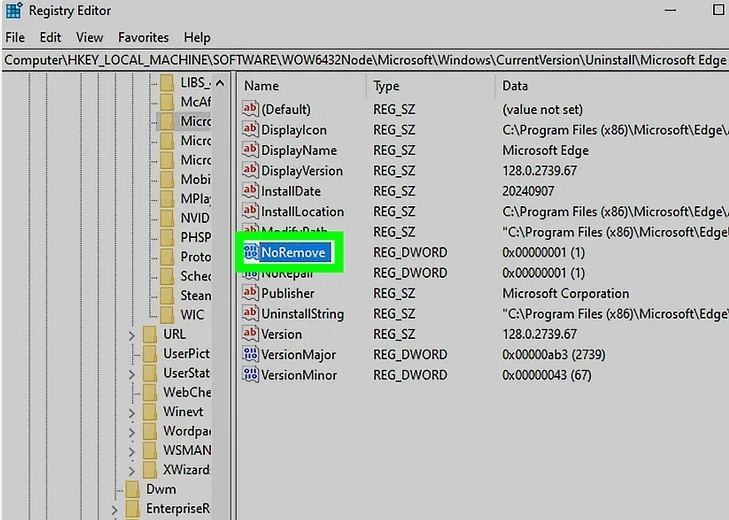
Double-click NoRemove in the right panel
Identifying the Locking Mechanism
On the right side of the screen, you will see a list of values; these are the specific rules applied to the Edge uninstaller. The value named “NoRemove” is the culprit—it is a digital lock that tells Windows, “Do not allow the user to remove this.”
How to Open the Value
- Look at the right-hand pane after selecting the Microsoft Edge folder.
- Find the entry named NoRemove.
- Double-click on the word NoRemove to open its editing window.
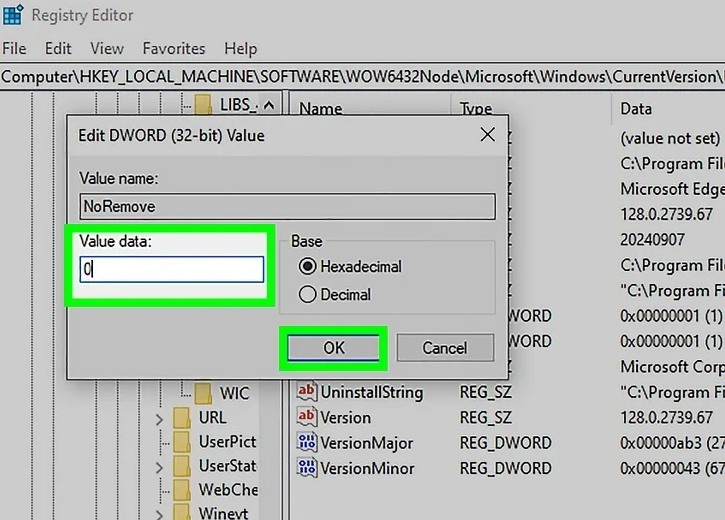
Change the “1” to a “0” and click OK
Flipping the Switch
This is the moment of truth where we disable the restriction using binary logic: 1 means “Yes, lock it,” and 0 means “No, unlock it.” By changing this single digit, you are instantly overturning the restriction that has been preventing you from removing the browser.
How to Edit the Data
- In the “Value data” box, delete the number 1.
- Type the number 0 in its place.
- Click the “OK” button to save the change instantly.
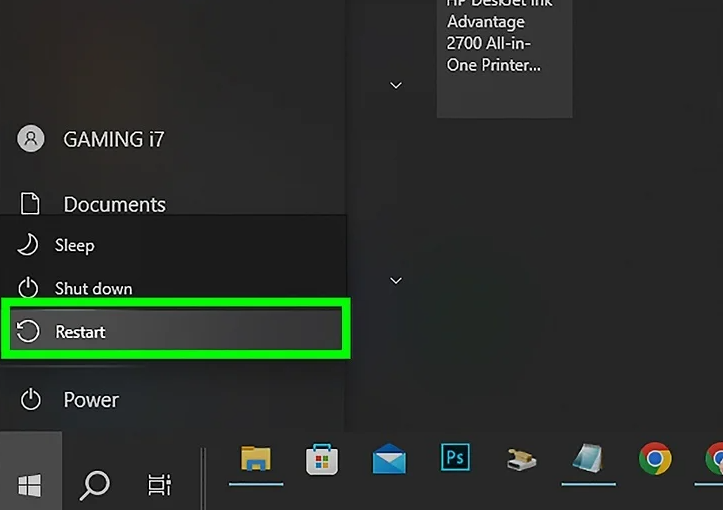
Restart your PC to apply the changes
Solidifying the New Configuration
While registry changes are often immediate, a restart ensures that the Windows Settings app refreshes its cache and recognizes the new permission. This acts as a fresh start for your system, loading the new configuration where the “Uninstall” button is no longer forbidden.
How to Reboot Properly
- Close the Registry Editor and all other open applications.
- Click the Start menu, select the Power icon, and choose “Restart.”
- Wait for your computer to boot back up to the desktop.
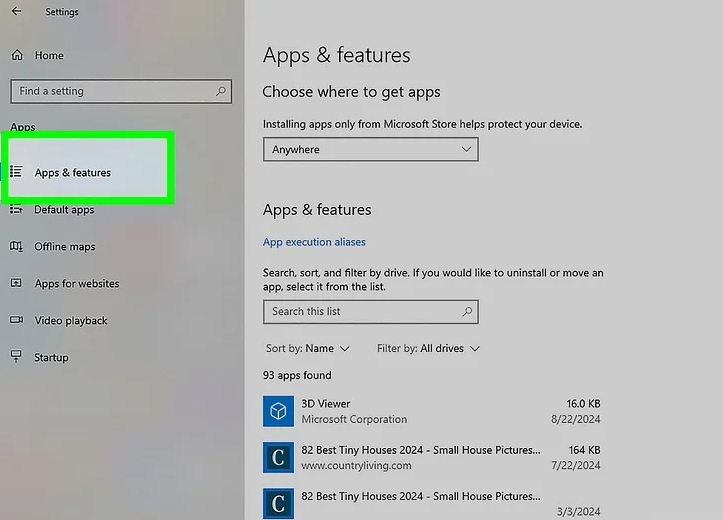
Navigate to your installed apps in Settings
Verifying the Success
Now that we have removed the digital shackles, it is time to return to the scene of the crime to verify our victory. You will go back to the same menu that once denied you, but this time, you will find a very different result waiting for you.
How to Check the Status
- Press Windows Key + I to open Settings directly.
- Click on “Apps” from the sidebar or main menu.
- Select “Installed apps” (or “Apps & features”) and search for “Microsoft Edge” in the list.
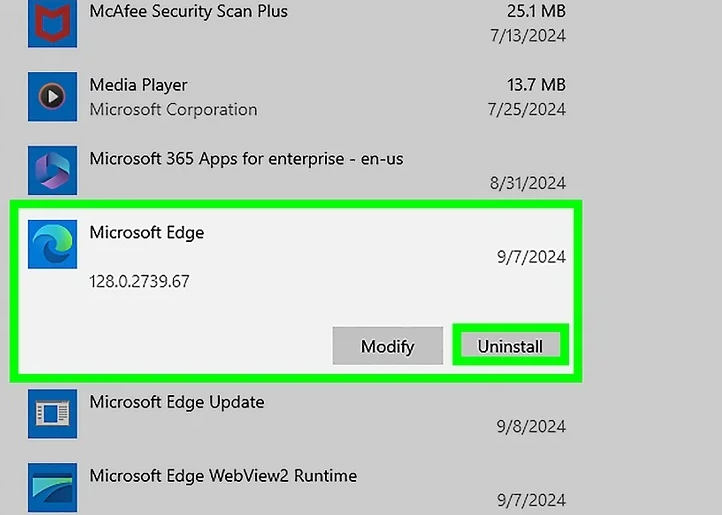
Remove Microsoft Edge
Executing the Final Command
The moment you have been waiting for is here; the “Uninstall” button is now active and ready to be clicked. You have successfully bypassed the system’s defenses and can now purge the unwanted browser from your machine, freeing up space and resources.
How to Uninstall
- Click the three dots (…) next to Microsoft Edge.
- Click the now-active “Uninstall” button.
- Confirm the prompt and watch as the browser is removed from your system.
Conclusion: A New Beginning for Your Digital Life
Congratulations. You have done what many thought was impossible. By taking these steps, you haven’t just removed a piece of software; you have asserted your authority over your own technology. It is a small victory, perhaps, but it signifies something much larger—the refusal to settle for a user experience that doesn’t serve you.
Think about the frustration you felt when you first searched for this solution, and contrast it with the satisfaction you feel now. That sense of relief is the power of taking control. You have decluttered your digital workspace, ensuring that your computer serves your needs, your preferences, and your workflow.
As you move forward, remember that technology is a tool meant to enhance your life, not dictate it. You now have the knowledge and the confidence to manage your system on your own terms. Enjoy your faster, cleaner, and truly personalized computer. You’ve earned it.
Frequently Asked Questions: Navigating the Edge Dilemma
You’ve got questions, and after two decades in the tech industry, I’ve heard them all. Dealing with pre-installed software can be confusing, so let’s cut through the technical jargon and get straight to the truth about Microsoft Edge.
Why can’t I uninstall Microsoft Edge?
Microsoft has reclassified Edge from a simple “application” to a “system component.” In their view, Edge is as vital to Windows as the taskbar or the file explorer. It powers background processes, the Windows Search bar, and the Widgets panel. Because of this deep integration, the standard “Uninstall” button is grayed out to prevent users from accidentally breaking these dependent features.
Is it safe to uninstall Microsoft Edge?
For the vast majority of users, yes. However, there is a caveat. While removing the browser interface is fine, you should be careful not to remove the “WebView2 Runtime” if you use other Microsoft apps like Outlook or Teams. These apps use the Edge “engine” to display content. As long as you follow the guide above and only target the browser application, your PC will remain stable, though links in the Start Menu (Search) may stop working or prompt you to choose a new default.
Is it possible to remove Edge from Windows 11?
Yes, it is possible, but not through the standard “Settings” menu. As detailed in our guide, you must modify the Windows Registry or use command-line tools (like PowerShell) to bypass the restrictions Microsoft has put in place. It requires a bit of “under the hood” work, but it is entirely achievable.
Is Edge better than Chrome?
This is the battle of the titans. Under the hood, both run on the Chromium engine, meaning they render websites almost identically.
- Edge is generally more efficient with RAM (memory) and CPU usage, making it better for laptops with limited battery life.
- Chrome offers superior synchronization with the Google ecosystem (Gmail, Drive, Android).
If you prioritize system performance, Edge has a slight advantage. If you live in the Google ecosystem, Chrome is the winner.
What are the alternatives to Edge?
If you want to escape the Microsoft ecosystem, you have excellent choices:
- Google Chrome: The most popular, robust extension library.
- Mozilla Firefox: The best choice for privacy enthusiasts, as it does not use the Chromium engine and is open-source.
- Brave: Incredible for speed and built-in ad blocking.
- Opera GX: Great for gamers who want to limit how much RAM their browser uses.
Why is it so difficult to uninstall Edge?
It comes down to market share and data. The browser wars are profitable. By making it difficult to leave, Microsoft ensures millions of passive users stay on Edge, which drives traffic to Bing and generates ad revenue. It is a design strategy known as a “dark pattern”—making the exit door hard to find so you eventually stop looking for it.
Is it possible to completely remove Edge from Windows 11?
You can remove the current installation, but “completely” is a tricky word with Windows. Microsoft often includes Edge re-installation scripts in major Windows Updates. You might successfully purge it today, only to find it back on your desktop after the next big system patch. It is a recurring battle, not a one-time victory.
Can Edge and Chrome coexist?
Absolutely. In fact, this is the most common setup. You can leave Edge installed for system tasks (or because you are forced to) but set Chrome (or Firefox) as your default browser. They do not conflict with each other, and you can import your bookmarks from one to the other in seconds.
Does Microsoft Edge track me?
Yes. Like most modern browsers, Edge collects telemetry data. It tracks your browsing history, search habits, and usage data to “improve the experience” and serve targeted ads. While you can adjust privacy settings to limit this, the default settings are quite aggressive in data collection.
Does Windows 11 force you to use Edge?
Windows 11 tries very hard to force your hand. Even if you set Chrome as your default browser, clicking a link in the Windows Widgets panel or the Search bar will often ignore your preference and open Edge anyway. Microsoft uses special protocol links (microsoft-edge://) instead of standard https:// links for system features to bypass your default browser choice.
Why do people refuse to upgrade to Windows 11?
The refusal often stems from a loss of control. Windows 11 introduced strict hardware requirements (TPM 2.0) and a more “locked-down” interface. The aggressive push of Microsoft Edge, the requirement to sign in with a Microsoft Account, and the increased amount of “bloatware” make many power users feel like they are renting their computer rather than owning it.
Is Microsoft Edge necessary?
The browser app itself is not necessary for your daily computing. You can browse the web perfectly fine without it. However, the Edge WebView2 Runtime (a background component) is often necessary for other applications on your PC to function correctly. You can safely remove the browser icon and application, but avoid uninstalling the runtime libraries if you want to keep your other apps running smoothly.

Sou Marisa Silva — Ao longo dos anos, desenvolvi um profundo interesse por temas que ajudam as pessoas a entender melhor a si mesmas e o mundo ao redor. O blog, que começou focado em interpretações de sonhos, hoje evoluiu para explorar uma variedade de assuntos — desde bem-estar, comportamento e desenvolvimento pessoal até temas do cotidiano que despertam dúvidas e interesse.